

Maktab management software
An evening maktab lives or dies on the daily lesson record — what each child read, what they take home, and whether the parent ever saw it. MarkTrack keeps that record in the notation your ustadh already uses, and puts it in the parent's pocket.
Updated August 2026
An evening maktab is a daily rhythm. Children arrive after school, read to the ustadh, are given something to take home, and leave. The entire institutional memory of that process is usually a exercise book with a teacher's initials in it — and if that teacher changes, the memory is gone.
MarkTrack is built to keep that daily record without changing how anybody teaches.
Record the lesson the way you already write it
The reason generic software fails a maktab is that it insists on a unit of work. A Hifz tracker assumes the unit is a passage of Qur'an. A gradebook assumes it is a percentage. A Qāʿidah lesson is neither — it is a chapter, or a page and a line, or a tajwīd rule, and no two maktabs write it the same way.
The Qaidah Tracker accepts all three notations. Each teacher records in the form they already use, the slots stay editable when someone gets it wrong, and the parent still sees a coherent history rather than three incompatible ones.
Homework that actually reaches the parent
Setting homework is easy. Knowing whether anyone saw it is the hard part.
Homework is set per student, a worksheet can be attached, and a note goes home the same day. You can see which parents have opened it — which changes the conversation at the door from "did you do your homework" to something you can actually act on. For children in a Hifz programme, sabaq, sabqi and manzil are recorded alongside, and both feed the report card at the end of the year.
Attendance without a clipboard
Maktab attendance matters for a specific reason: fees. A parent who believes their child attended eighteen sessions and is billed for twenty will call, and the answer has to be better than a memory. Attendance in MarkTrack is timezone-correct, lockable once a period closes, and leaves an audit trail if someone edits it later.
Fees, whether or not you take cards
Many maktabs collect cash and intend to keep collecting cash. That is fine — you can raise invoices and keep a record of who has paid without processing a single card. When you do want to stop chasing, the card side is there: the registration fee at enrolment, a card kept on file, and a recurring schedule that ends automatically at the end of the year.
Getting started without retyping your register
Most maktabs already keep a list of families somewhere — a spreadsheet, a shared document, a printed sheet in a folder. Whatever form it is in, the AI import maps the columns for you, shows you the families it found, and creates the accounts once you approve them. Nobody spends an evening retyping names.
See it
The parts of MarkTrack this kind of school spends its time in.
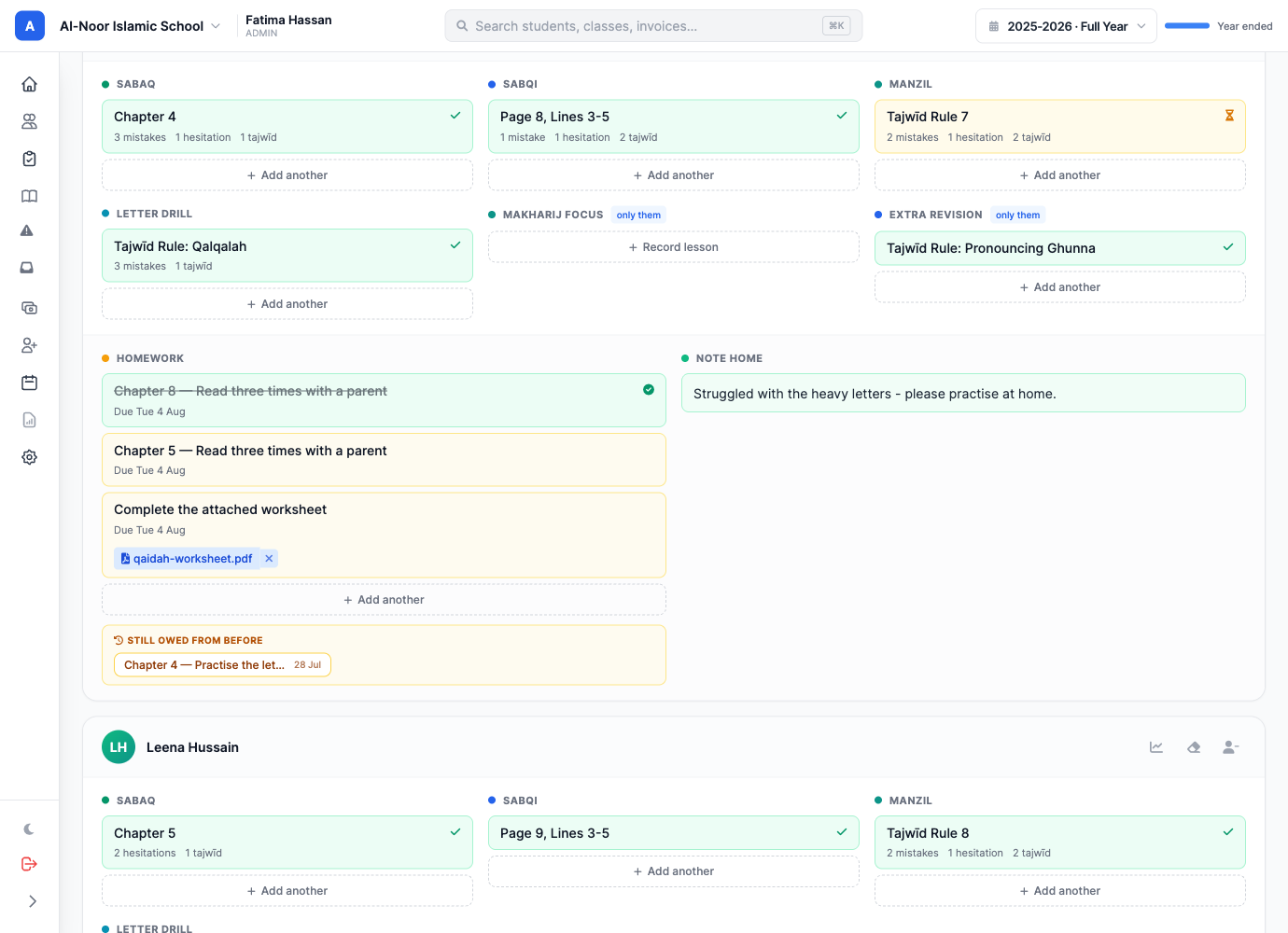
The Qāʿidah Tracker
Every child's daily lesson at a glance, recorded as a chapter, a page and a line, or a tajwid rule — whichever notation your maktab already uses.
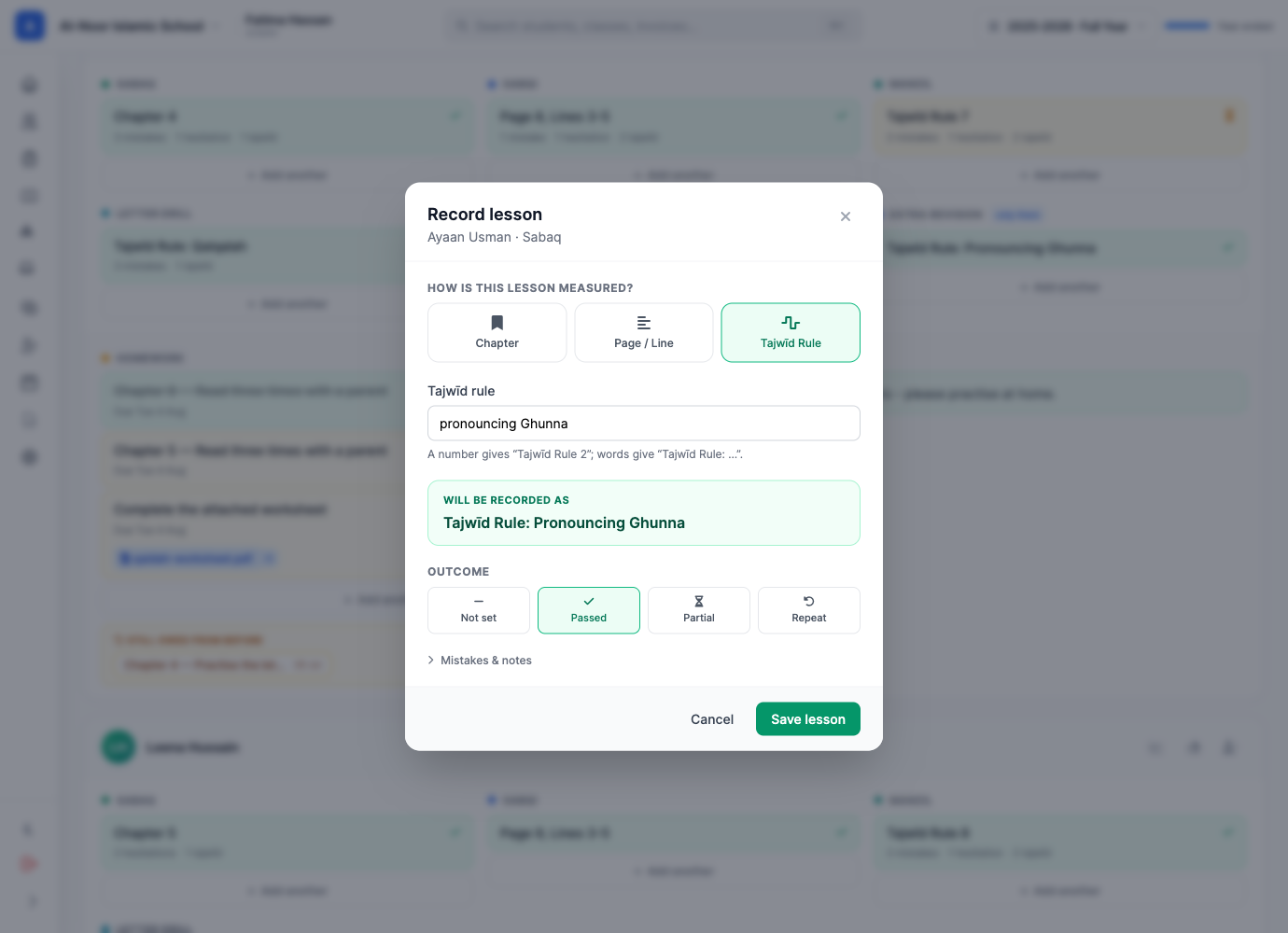
Recording the day's lesson
The slot stays editable, so a teacher who gets it wrong on Tuesday can fix it on Wednesday without an administrator.
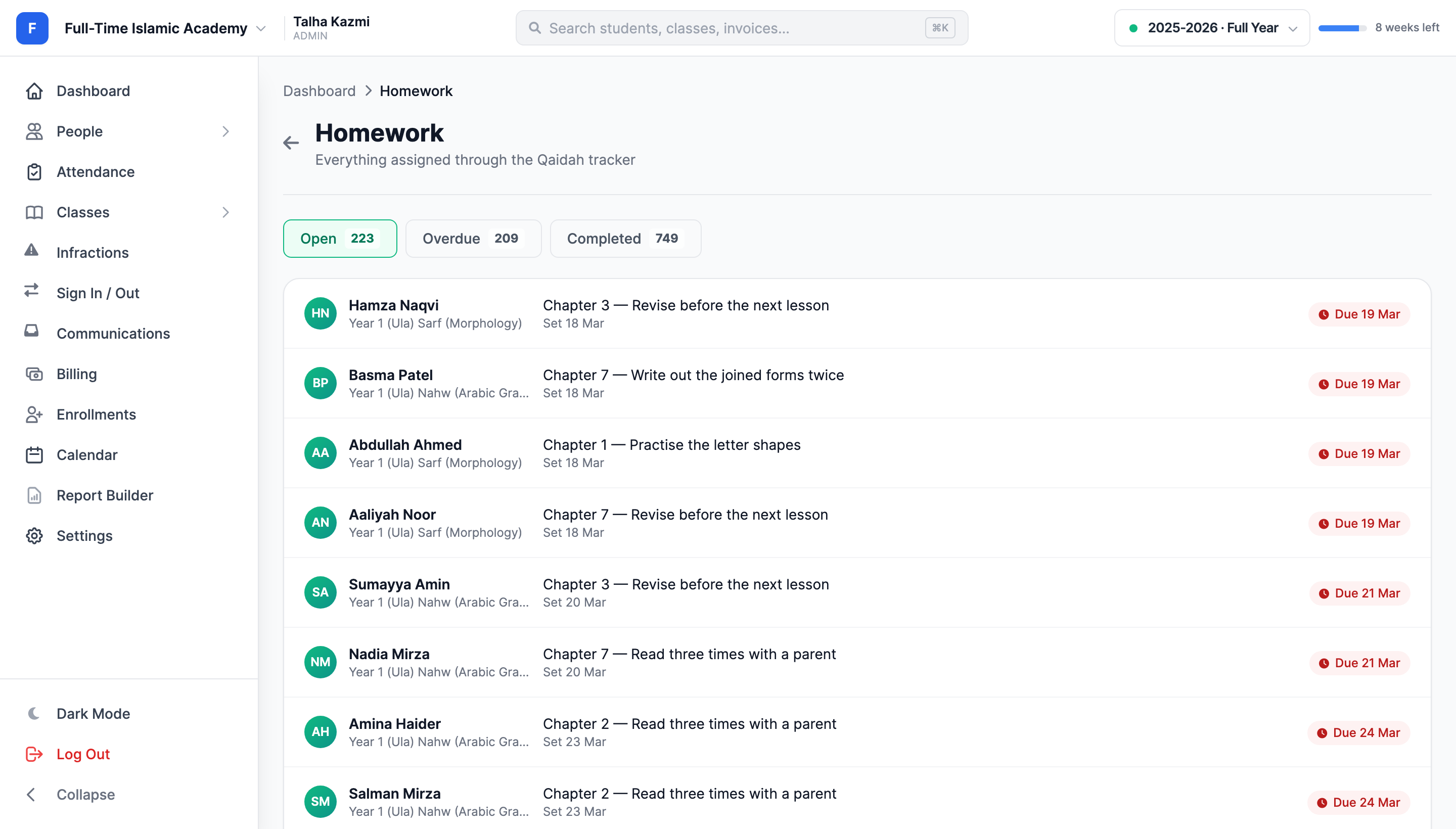
Homework, set per child
Different homework for different children, with a worksheet attached, and a note that goes home the same evening.
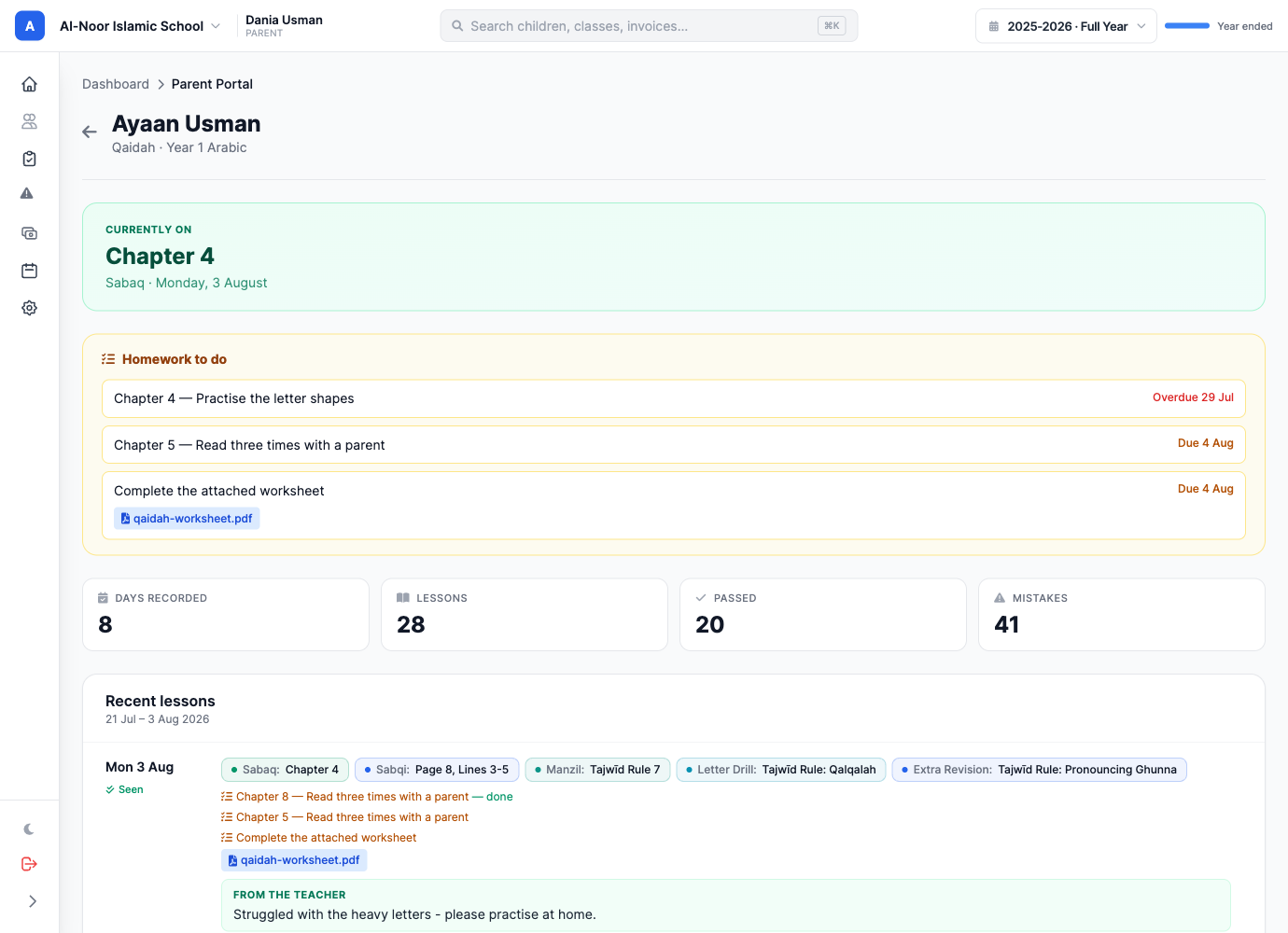
What the parent sees
The parent gets the lesson and the homework in their own app — and you can see who has actually opened it.
Questions schools ask us
01 Our teachers record lessons differently from each other. Does that break it?
No. The Qaidah tracker takes the day in three notations — a chapter, a page and a line, or a tajwid rule — so each teacher records the way they already do and the parent still sees a coherent history.
02 Can parents see what their child has to do at home?
Yes. Homework is set per student, a worksheet can be attached, and the note home goes out the same day. You can see which parents have opened it.
03 We collect fees in cash. Do we have to change that?
No. You can keep an invoice record without taking card payments at all, and turn on card or autopay later if you want to stop chasing.
04 How long does it take to get a maktab set up?
Most set themselves up in an afternoon. If you already keep a spreadsheet of families, the AI import reads it as-is and creates the accounts once you approve them.
More from MarkTrack
See it with your own school's data
Start a 30-day free trial, or bring the spreadsheet you already keep and we will show you what it looks like once it is imported. No card required to start.