
A life
The House of Children: the life and method of Maria Montessori
In the last years of the 1800s, a young doctor in Rome started spending a lot of her time in asylums. She went for work. She was on staff at the university's psychiatric clinic, and part of her job was to walk the wards and pick out which patients might be worth bringing in for study. It was grim work, and it wasn't made any easier by the fact that Rome had not yet made up its mind about whether it wanted women doctors at all. She went anyway. Month after month she went through the iron doors and down the corridors that smelled of carbolic and old plaster, and she looked at what her century had decided to do with the people it couldn't explain.
One of the wards held children. These were the kids nobody had a real name for yet. The registers called them deficient, or idiot, words that weren't insults at the time but diagnoses, and that meant, in practice, that a child had been put somewhere out of the way and wasn't coming back. They were fed. They were housed. Past that, nobody was required to do anything at all. The rooms where they spent their lives were bare, and everyone thought this was sensible, since furniture breaks and small objects get swallowed, and these children weren't considered capable of using either.
The story that's come down to us, and it's worth saying up front that it comes from her biographers rather than from her own hand, is that she stood watching these children one day as they crawled around the floor picking up the crumbs of their bread. The attendant with her described it with disgust, as proof of how coarse they were, how animal. The young doctor looked at exactly the same scene and read it the opposite way. The children weren't hungry. They had just been fed. What they were doing on that floor was the only thing left in the world available to them to do. They were reaching for the only objects the room contained.
Whether the crumbs are literally true or not, the conclusion is definitely hers, and she put it in print a few years later in words that are colder and therefore worse. These children, she wrote, had nothing to handle. The rooms were empty. And a mind, especially a small one, does not grow on air.
Her name was Maria Montessori, and at this point in the story she was not an educator. She had no classroom, no training in teaching, no theory of instruction, and no particular interest in schools. She was a physician specializing in nervous disease, and everything that came afterward grew out of clinical habit rather than philosophy: look very hard at something for a very long time, and refuse to say anything about it you haven't actually seen.
I. Chiaravalle
She was born on August 31, 1870, in Chiaravalle, a small town in the province of Ancona, in a country that was still busy inventing itself. Rome wouldn't become the capital of a unified Italy until the following month. Her father, Alessandro, worked for the finance ministry and held firm, conservative opinions about what daughters were for. Her mother, Renilde, came from a family that owned books and had the unusual distinction, for a woman of her class and generation, of having read most of them. The daughter got pulled between the two of them, in the direction she would keep traveling for the rest of her life.
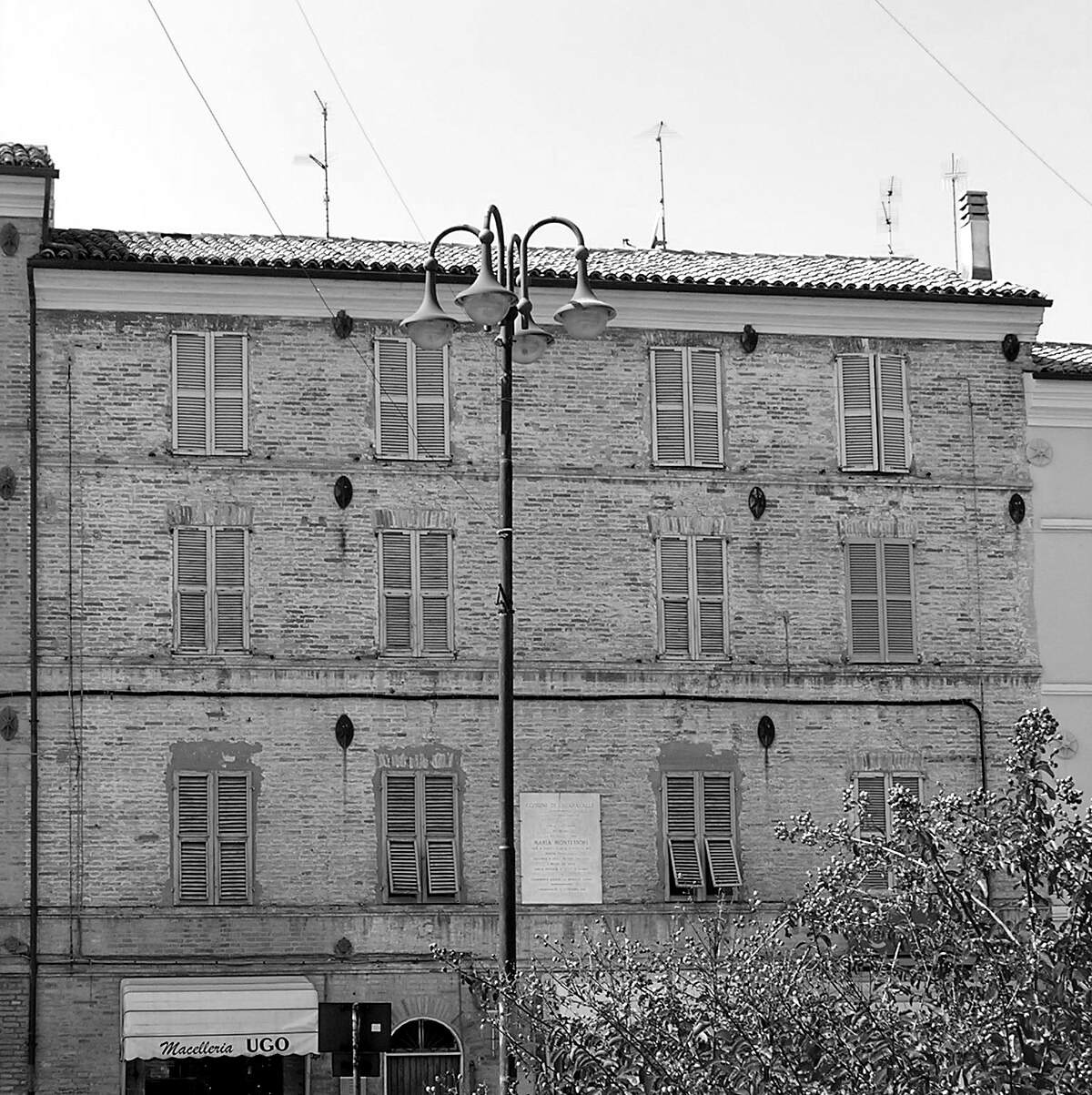
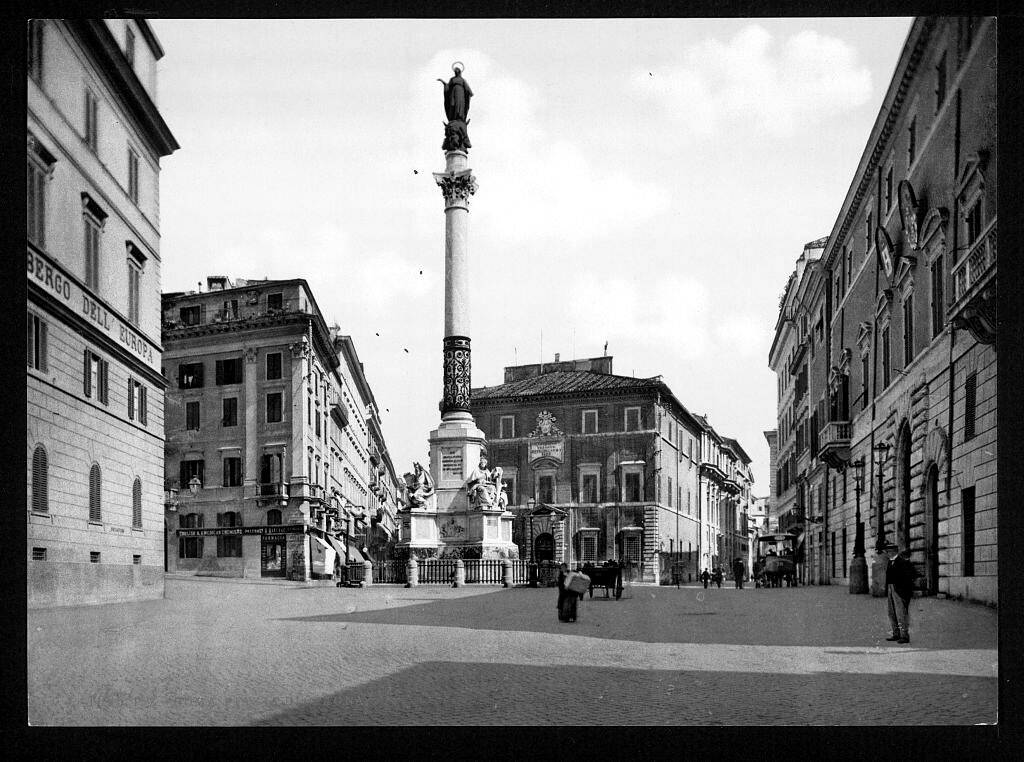
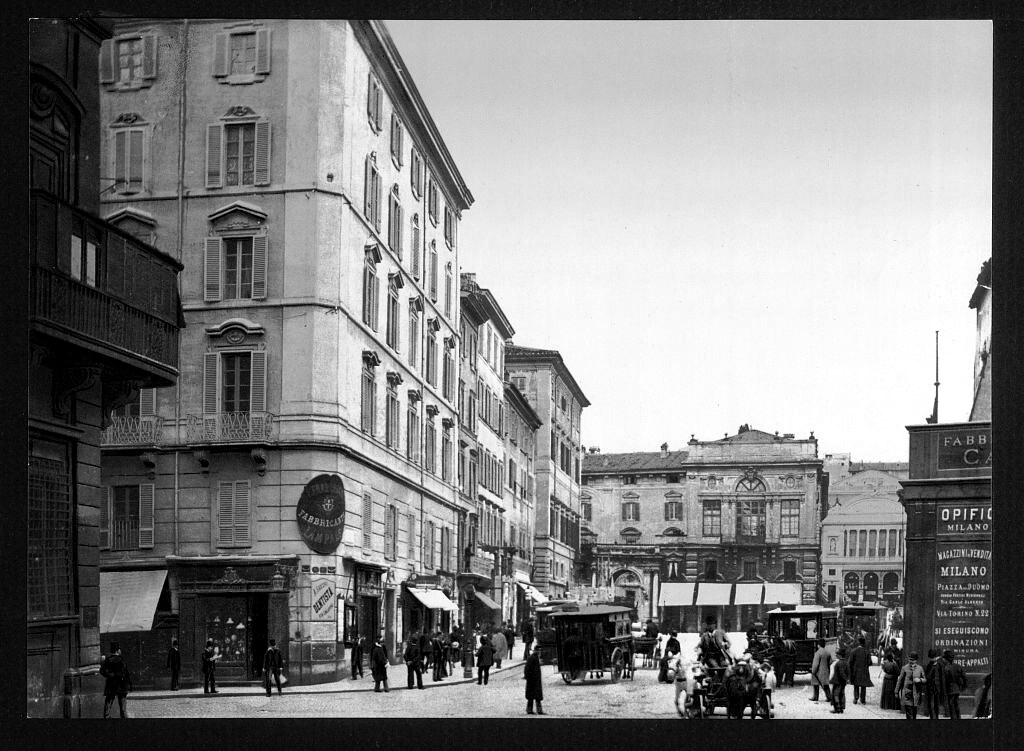
The family moved to Rome when she was five, and Rome is where the trouble started, in the slow grinding way that trouble usually starts, which is to say over the question of what school a girl was allowed to attend. At twelve she wanted math. At thirteen she enrolled, over her father's objections, in a technical school full of boys, because that's where the math was. She planned to become an engineer, an ambition so far outside the acceptable range that the household seems to have received it less as rebellion than as a category error.
Then, sometime in her late teens, she changed her mind and settled on medicine instead, which was worse. Engineering was merely inappropriate. Medicine was closed. There's a durable story, impossible to verify and too good to leave out, that she went to see the professor who had turned her down and told him on her way out of the room that she was going to become a doctor of medicine, and that she knew it. What's certain is that by 1893 she was in the medical faculty at the University of Rome, and that in 1896 she took her degree, one of the first women in Italy to do it.
The degree cost her more than the exams did. Because it was considered indecent for a young woman to look at a naked body in mixed company, she had to do her dissections alone, in the evenings, after the other students had gone home. Sit with that for a second, because it explains a lot about the rest of her life: a woman barely into her twenties, alone in a cold room in the Roman winter, working by lamplight over a cadaver, in a building emptied of every single person whose good opinion she was supposed to want. She's said to have walked out once, sat down in the street, and thought seriously about quitting. She went back in.
II. Two Frenchmen and a lot of late nights
Having seen the children in the asylum, she did what a scientist does, which is go find out whether anybody had gotten there first. Two people had. The first was Jean Marc Gaspard Itard, a French physician from the Napoleonic era who had been handed a boy found living wild in the woods of Aveyron and spent five patient years trying to teach him, with results the world called a failure and that Itard, more honestly, called partial. The second was Itard's student, Édouard Séguin, who took the same principles and built them into a full physiological method for educating the children everyone else had written off. It started not with the intellect but with the hand, the ear, the eye, the weight of an object in the palm.
Montessori sat down and translated them. Not read them. Translated them, by hand, line by line, from French into Italian, and later from English too, several hundred pages of it, at night, over a period of years. She said afterward that she did it deliberately, because copying a man's words in your own handwriting is the only way to be sure you've actually understood him instead of skimming him. It's an old scholar's trick and a slow one, and the fact that she picked it tells you something about the kind of mind she had.
There's a private grief running underneath these years that the standard accounts used to leave out and that no honest version can. In 1898, while she was working at the clinic, she had a son, Mario. The father was her colleague Giuseppe Montesano. They didn't marry. For an unmarried woman in Catholic Rome in 1898 to be publicly known as a mother would have ended her career on the spot, so the boy was sent to be raised by a family in the countryside outside the city. She visited the way a benefactor visits, and she didn't tell him who she was until he was nearly grown. He came to her in adolescence, and once he came he never left. He worked beside her for the rest of her life and buried her at the end of it. But she spent the decade in which she made her name as a woman who had given up her own child in order to be allowed to work with other people's. It doesn't resolve into a lesson. It just sits there.
III. The exam
In 1900 she was made co-director of a small institute in Rome that trained teachers to work with so-called deficient children, and for two years she did something there that she later called the real foundation of everything. She taught the children herself, from eight in the morning until seven at night, every day, and she watched them.
She gave them Séguin's apparatus and built more of her own. She gave them things to touch, sort, fit, weigh, and match. She gave them letters cut out of sandpaper so a finger could learn the shape of an A before the mind was asked to name it. And then, at the end of it, she entered a group of these children, the ones the state had already given up on, in the public exams written for the ordinary schoolchildren of Rome.
They passed. Several of them scored above average.
The world called it a miracle and made a fuss over her, and she found the applause close to unbearable, because everybody was drawing the wrong conclusion. They thought she had worked a miracle on the defective. What she saw was an indictment of everyone else. If children carrying every disadvantage the century could load onto them could be brought level with the ordinary schoolchildren of Rome, then the interesting question wasn't what had lifted the first group up. The interesting question was what was holding the second group down.
That question is the seed of the entire method, and it's worth being precise about its shape, because it isn't the question most reformers ask. She didn't ask how children could be taught better. She asked what schooling was doing to children that stopped them from becoming what they would otherwise have become. It's a subtractive question. Almost everything she built afterward was an attempt to take something away.
IV. Fifty children and an empty room
Her opening, when it came, arrived disguised as a nuisance.
East of the railway station, past the old wall, was the San Lorenzo quarter: a district thrown up fast during the building boom of the 1880s, abandoned when the money ran out, and occupied ever since by the poorest working families in the city. A property association had taken on the job of rehabbing several of these tenement blocks. They had rebuilt the buildings nicely enough. What they hadn't solved was the children.
The parents of San Lorenzo went out to work. The older kids went to school. That left, in every block, a floating population of two to six year olds with nowhere to be and nothing to do, who spent the entire working day on the stairs and in the courtyards of the brand new buildings and were, with the thoroughness available to the very young, destroying them. The association wanted its walls left alone. Somebody suggested rounding the children into a room, and somebody else suggested the lady doctor who'd had that strange success with the deficient children, and so, on January 6, 1907, at 53 Via dei Marsi, a door opened onto a big plain room and about fifty children were put inside it.
They called it the Casa dei Bambini, the House of Children. There was basically no ceremony. Montessori remembered it later with a kind of amazement at how little anyone had expected: no journalist showed up, no minister, nobody at all except the families, who were mostly illiterate and had mainly been told that their children would be kept clean and kept indoors.
And here's the detail the whole century turns on. Montessori did not teach in that room. She couldn't. She had lectures, a practice, a hundred other obligations. The person put in daily charge of fifty slum children was the daughter of the building's porter, a young woman with no education and no training in teaching whatsoever, and she was given essentially one instruction, which was not to interfere. Show the child how the thing works. Then step back. Then watch.
It's hard to overstate how strange this was. The classroom of 1907 was a place of instruction in the most literal sense: adult at the front, children in rows, material poured from the full vessel into the empty ones. What got set up on Via dei Marsi was the exact inverse. The room was furnished with small tables and small chairs light enough for a four year old to carry, which Montessori had made specially and which struck visitors as an eccentricity bordering on comedy. The materials sat on low shelves. And the adult, once she had demonstrated, was supposed to keep quiet.
V. What the children did
What happened over the next eighteen months is the reason anyone still says her name, and the striking thing about her own account of it is how consistently she presents herself as having been caught off guard. She doesn't write like a woman whose theory got confirmed. She writes like a woman who kept being surprised, and who had the professional honesty to write the surprises down instead of tidying them away.
The first surprise was concentration. A girl of about three picked up a set of wooden cylinders, the kind that have to be fitted into matching sockets, and started working at them. She finished, tipped them out, and did it again. Montessori, curious how far this would go, started counting. The child repeated the exercise 42 times. To test whether the absorption was real, Montessori had the other children sing loudly around her. The girl didn't look up. She had the child's little chair picked up bodily, child still in it, and moved. The girl kept working in midair with the cylinders in her lap. Then, at some point known only to her, she stopped, put the thing down, and looked around like somebody surfacing from deep water. She seemed, Montessori wrote, rested and content.
Nobody had told the child to do this. Nobody had rewarded her for it. The exercise had no practical use whatsoever. And the effect of it on her afterward was visible in the room, in her face and the way she carried herself, for the rest of the day.
The second surprise involved a cupboard. The materials were kept in a tall cabinet that the directress was supposed to unlock and hand things out of, in the normal way. One morning she was late, or careless, and left it open, and when Montessori arrived she found the children helping themselves: choosing what they wanted, carrying it to their tables, putting it back, choosing again. Her first instinct was that they were stealing. Her second, and the one she acted on, was that the cupboard was the problem. She had the tall cabinet hauled out and replaced with low open shelves within reach of a small arm. Every Montessori classroom in the world has looked like that ever since, and it started as an accident that a woman was willing to be corrected by.
The third surprise was the toys. There were toys in the room, good ones, and she had assumed the children would go straight for them and put up with the exercises as the price of the playthings. Given a free choice, the children went to the work. They wanted to pour water from one pitcher into another without spilling it. They wanted to button and unbutton buttons on a frame. They wanted to sweep the floor and polish the brass and set the table and wash their own hands in their own basin, and they wanted to do these things not once but over and over, with total seriousness, and with a strong preference for being allowed to finish. The toys got ignored. When she tried to interest them in a dollhouse, they were polite about it and went back to the buttons.
The fourth surprise was rewards, and it embarrassed her, because she had shown up with a system of little prizes and medals in the style of the day. The children were unimpressed. She watched a boy who had been given a medal take it off and hand it to another child who wanted it, with the air of a man getting rid of a piece of trash. She found candy handed out as prizes sitting forgotten in pockets and on the floor. They weren't being noble. It was simpler and more devastating than that: the work was already enough, and the medal was beside the point. She got rid of the prizes. She got rid of the punishments at the same time, having discovered she no longer had anything to punish.
There's one scene from those months that reads more like fiction than like a physician's notes, and she used it for the rest of her life. A woman came into the room carrying a sleeping baby a few months old. The children gathered around, and Montessori said to them, more or less, that this infant was quieter than any of them could ever be. They took it as a challenge and went silent. Then, seeing that it could be done, they went further. They stopped fidgeting. They stopped breathing loudly. They held themselves so still that the ordinary sounds of the building came up through the floor and into the room, a cart in the street, a bird, water somewhere. Fifty small children from the tenements of San Lorenzo sat in complete stillness because they had discovered that stillness was something a person could pull off. She called it the game of silence and it became a permanent fixture of the method.
VI. The explosion
She hadn't planned to teach them to read or write. They were four and five years old. Italian schools didn't attempt it before six, and she had no interest in being accused of forcing infants. What she had given them, for completely different reasons, were letters cut out of sandpaper and mounted on card, which the children traced with two fingers while she or the directress made the sound the letter stood for. It was an exercise for the hand and the ear. She thought of it as preparation, the way you prepare a field years before you plant it.
The mothers of San Lorenzo had asked, more than once, that their children be taught to write, and she had put them off. She finally gave in, half-heartedly, and set out a movable alphabet, a box of separate cut-out letters a child could arrange on a mat, so words could be built without the labor of forming them with a pen.
In the fall of 1907 a five year old boy, sitting on the terrace in the sun with a piece of chalk, wrote a word. Then he wrote another. Then, according to her account, he started shouting: I can write! I can write! The other children came running, and there was the kind of commotion that breaks out when a rumor of treasure goes around, and within days they were writing on the blackboards, on the walls, on the pavement outside, on the shutters, on any surface that would hold a mark, in a state she could only describe as intoxication.
She hadn't taught them to write. She had taught them, separately and for their own sakes, to hold a pencil, to trace a shape, to hear a sound, to recognize a form by touch. The writing assembled itself out of those parts, all at once, with no lesson, the way a machine built piece by piece on a bench turns over on the first try. Reading came afterward, more slowly, and struck them as far less interesting. It took some of them months to get that the marks other people made carried the same freight as their own. She called the phenomenon an explosion, and the word stuck.
Within two years the House of Children on Via dei Marsi was one of the more remarkable sights in Europe. Visitors came from Britain and America and found, in a rebuilt tenement in the poorest quarter of Rome, a room full of four year olds moving around quietly on their own business, choosing their own work, catching their own mistakes, putting their own things away, and writing, and doing all of it in the presence of an adult who appeared, to the untrained eye, to be doing nothing at all.
VII. What the method actually is
It's worth pausing the story to lay out what she actually built, because the word Montessori has since been stuck on so many things that it has nearly stopped meaning any of them.
At the center is the prepared environment. The room isn't a container for teaching. The room is the teaching. Everything in it is scaled to the child: the tables, the chairs, the shelves, the pitchers, the brooms, the basin. Everything has a place and goes back to it. Everything is real and breakable, china instead of tin, because a thing that can break is a thing that teaches care, and because handing a child something unbreakable is a way of telling them you don't trust them.
The materials on the shelves aren't toys and aren't illustrations. Each one isolates a single quality and varies nothing else. The Pink Tower is ten wooden cubes identical in color and material, differing only in size, so that the hand and the eye meet the idea of dimension on its own, with nothing else in the way. And each one carries what she called the control of error, which is the quiet revolution in the whole system. If the cylinder doesn't fit the socket, the child knows. Not because a teacher said so, and not because it got marked wrong in a book. The material told them, privately, without judgment, and they can try again as many times as they want. That takes the correction of error away from the adult entirely, and it takes with it the whole apparatus of approval and disapproval that children are normally governed by.
There's freedom of choice inside limits. The child picks their own work, stays with it as long as they want, and puts it back before taking something else. They can't take work another child is using, they can't disturb that child, and they can't damage the room or the people in it. Inside that fence they're free, and the freedom isn't a reward for good behavior. It's the condition under which the good behavior shows up at all.
There's the long uninterrupted work cycle, ideally three hours, no bells, no chopping the day into forty minute blocks to fit an adult's timetable. The kind of concentration she had watched in the girl with the cylinders takes time to build and is destroyed by interruption, and a school that interrupts a child every forty minutes has made a decision, whether it realizes it or not, about how deep it wants that child's attention to go.
There are mixed ages, in spans of about three years, so that a class holds three, four and five year olds together. The younger ones watch the older ones and see, laid out in front of them, what they're about to become. The older ones teach the younger ones, which is still the only reliable way anybody has found to check whether you actually understand something.
And there's the adult, who she called the directress rather than the teacher, and whose skill is almost entirely restraint. The job is to prepare the environment, to give an individual child the shortest possible presentation of a material at the moment they're ready for it, and then to get out of the way. Montessori was harsh about this, harsher than her admirers usually are. An adult who helps a child do something the child could have done alone has not been kind. They've taken something.
Underneath all of it sit the two ideas she gets quoted for most. The first is the sensitive period: the observation that a child passes through windows of short-lived and almost ferocious appetite, for order, for language, for tiny objects, for movement, for social manners, during which they'll pick up the matching capacity almost effortlessly and with obvious joy, and after which the same thing will cost them real work. The second is the absorbent mind: her claim that a child under six doesn't learn the way an adult learns, by applying effort, but takes in the whole environment indiscriminately, the language, the manners, the tempo, the attitudes, the way a plant takes up water. Which means the most important educational decision anybody makes about a small child isn't what to teach them. It's what to surround them with.
VIII. The world falls in love
In 1909 she ran a training course in a villa in the hills above Rome and wrote the book that came out of it. Translated into English in 1912 as The Montessori Method, it went through printing after printing and made her, inside of about three years, one of the most famous women alive.
America received her with the particular violence of its enthusiasms. She crossed the Atlantic in 1913 to lecture. Alexander Graham Bell and his wife took up her cause. There was a Montessori society, and a magazine, and a model classroom installed inside a glass walled room at the great exposition in San Francisco in 1915, where visitors sat in tiers and watched twenty children work as though they were attending an opera. She was awarded two gold medals for it.
Enthusiasm at that pitch has a short half-life. In 1914 a professor at Teachers College in New York named William Heard Kilpatrick published a short and effective book examining her system, and concluded that it was about fifty years out of date, that its sensory materials were formalistic, and that its exclusion of imaginative play was a serious defect. He was influential, the mood turned, and within a few years the American enthusiasm had collapsed almost completely. It wouldn't really come back for another forty years.
She didn't help her own case. By every account, including the friendly ones, she was controlling about her name. She insisted that only she could train teachers, kept a tight grip on the manufacture of the materials, and treated deviation as corruption. It's a defensible instinct in a woman watching her work get watered down, and it cost her the country that might have carried it furthest.
IX. Exile
The politics of the century came for her the way they came for everybody.
Mussolini's government took an early interest, and for a while the arrangement suited both sides. There were Montessori schools in Italy under state patronage and she was given honors. It couldn't hold, because what she was building and what he was building were incompatible at the root. A method whose first premise is that the child chooses, and whose goal is a self-governing person, cannot be run by a state that needs uniformed children marshaled into ranks and swearing oaths. By 1933 the relationship had broken down completely. She left Italy in 1934. In 1936 the regime shut the Montessori schools. In Germany they had already been shut and her books had been burned in the square.
She went to Barcelona, and then, when the Spanish war made Barcelona impossible, to the Netherlands. And in 1939, at the age of sixty eight, she accepted an invitation from the Theosophical Society to teach a training course at Adyar, outside Madras, and sailed to India with her son.
She had planned to stay a few months. Then Italy entered the war, and Maria and Mario Montessori, Italian nationals in British India, became enemy aliens on paper. Mario was interned in a camp. Maria, seventy years old, was confined to the Society's estate. The story goes that the government of India released her son to her on her seventieth birthday as a birthday gift. That detail has the polish of something improved by retelling, but the internment itself is real enough.
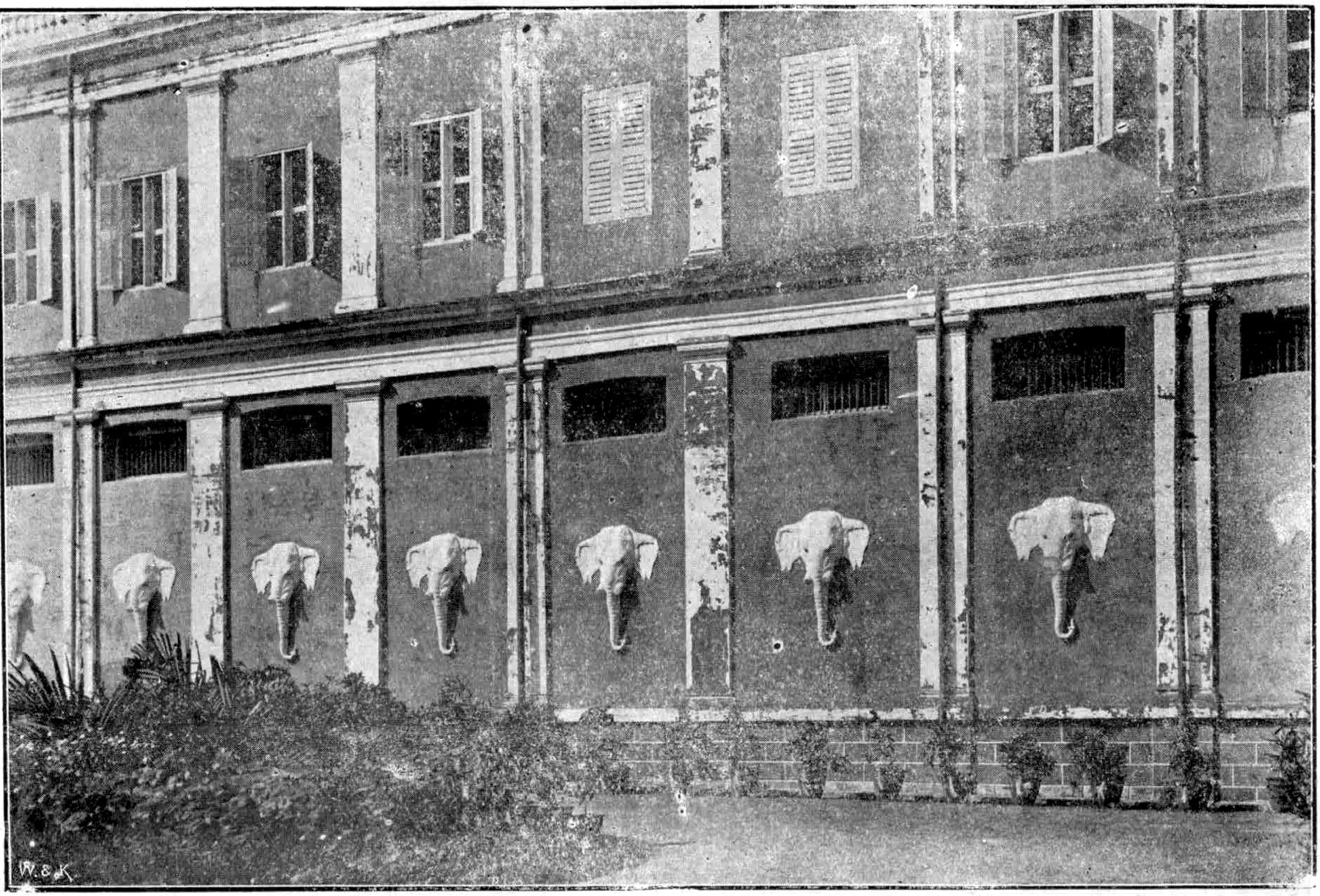
Seven years is a long confinement for a woman in her seventies, and it turned into the most productive stretch of her later life. Cut off from Europe, from her organization, from the constant travel and the fights over trademarks, she had nothing to do but think and teach. She trained something over a thousand Indian teachers. She worked out, for children between six and twelve, the scheme she called Cosmic Education, whose premise is that an older child is no longer satisfied by the concrete and needs the largest possible frame instead: the formation of the earth, the arrival of life, the appearance of human beings, the invention of language and number, and their own small place and resulting responsibility inside all of it. And at Ahmedabad she gave the lectures that became The Absorbent Mind.
The war also finished the job of turning her from a teacher into something closer to a moralist. She had watched two European wars and the burning of her own books, and she had landed on a conclusion that she stated with more force than qualification: that establishing peace is the work of education, and that politics can do no more than keep us out of war, which is a different and much smaller thing. She was nominated for the Nobel Peace Prize six times between 1949 and 1951. She never got it.
X. Noordwijk
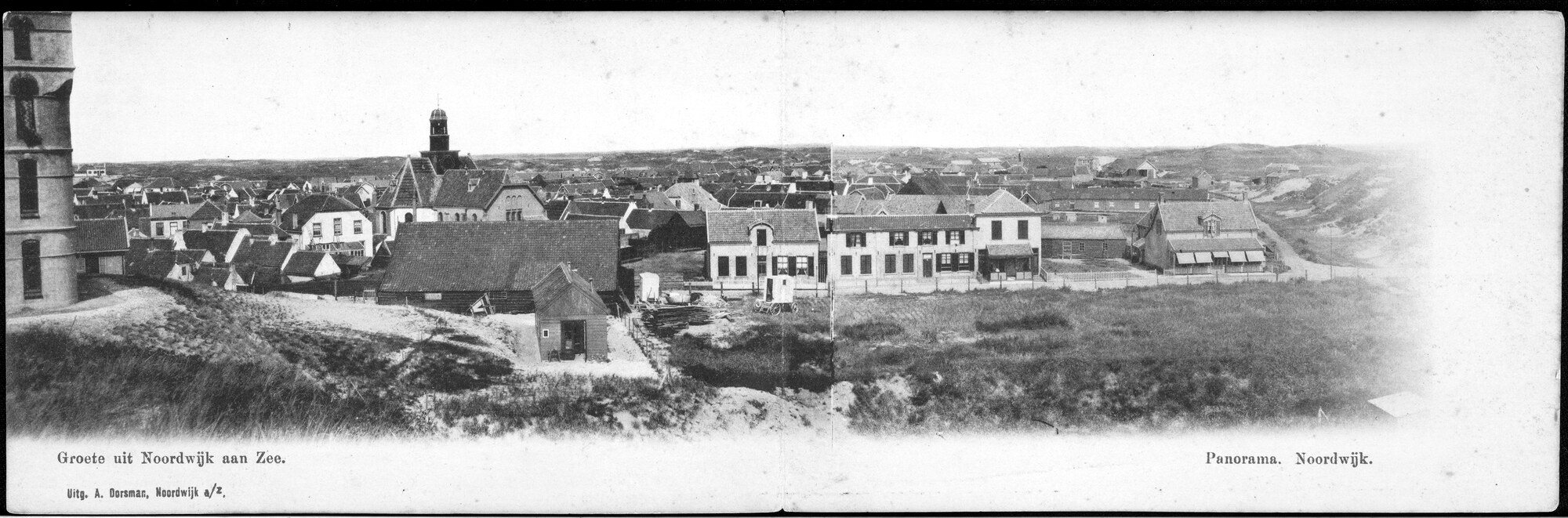
She came back to Europe in 1946 and could not be talked into stopping. There were congresses, courses, honors, an address to UNESCO. In the spring of 1952 she was at Noordwijk aan Zee, a small town on the Dutch coast north of Leiden, staying with friends, and there was a plan in motion for her to go to Ghana to help set up schools. She was eighty one. Mario is supposed to have suggested letting somebody else make the trip, and she's supposed to have asked him whether he thought she was no longer of any use.
She died there on the sixth of May, of a cerebral hemorrhage, in a country that wasn't hers, within earshot of the North Sea. She was buried in the Catholic cemetery at Noordwijk instead of being carried home to Italy, and the choice was deliberate. She had said she belonged wherever she happened to be, like a citizen of the world.
The stone over her carries a sentence she wrote, and it's addressed, the way almost everything she wrote was addressed, past the adults and straight to the children: a request that they, who are able to do all things, join her in building peace between people and in the world.
XI. Was she right?
A hundred and twenty years later, it's fair to ask what survives the affection.
The honest summary is that the method does pretty well when it gets tested, and that it has been tested far less often than its age and reach would lead you to expect. The strongest evidence comes from a natural experiment: public Montessori schools that are oversubscribed and admit by lottery, so the kids who get in and the kids who don't come from the same pool of families. Comparing the winners to the losers removes the objection that hangs over everything else in this field, which is that Montessori parents are just unusual to begin with.
Using the Milwaukee lottery, Lillard and Else-Quest reported in Science in 2006 that five year olds who won places outscored those who didn't on early reading and math, on executive function and on social reasoning, and behaved differently on the playground. At twelve they wrote more sophisticated prose and reported a stronger sense of community. The sample was small, 55 children, and the authors said so. A larger lottery study published in 2017 followed 141 children through three years of preschool in a high poverty American city and found not just bigger gains in achievement and in enjoyment of school, but something more interesting: the gap between the poorer Montessori children and their wealthier conventionally schooled peers had closed to the point of statistical insignificance. The most careful synthesis so far, a 2023 Campbell systematic review of 32 solid studies across eight countries, found a modest positive effect on academic outcomes and a slightly bigger one on the things she actually cared about: executive function, creativity, social skill, wellbeing at school.
Against all of that, a few things have to be said.
The first is that her name protects nothing. In the 1960s, during a fight between rival Montessori organizations, the United States Patent Office ruled that the word had become generic, which means anybody at all can paint it on a door, with no training, no accreditation and no obligation to do any of the things described above. The irony is exquisite given how fiercely she guarded it while she was alive. The consequence is that when you're told a school is Montessori, you've been told almost nothing.
The second is that this matters more than you'd hope, because fidelity appears to be load-bearing. A study by Lillard in 2012 compared classic Montessori classrooms, Montessori classrooms supplemented with conventional activities, and ordinary preschools, and found that the children in the classic classrooms gained the most, while the supplemented classrooms didn't reliably beat the conventional ones. Half the method is not half the benefit.
The third is that lotteries only randomize among families who entered the lottery in the first place, that the effects look bigger in private settings than public ones, and that the evidence thins out sharply above the elementary years, so the case for Montessori adolescence is still mostly a case from first principles.
And the fourth is Kilpatrick's, which has never really been answered: a room where every object has a correct use and a built-in control of error is a room where a certain kind of unruly, inventive, pointless pretending doesn't easily happen. Montessori thought fantasy in the early years was a distraction from a child's serious business of mastering the actual world. She may have been right. Either way it's an argument about what a childhood should contain, not one a test score can settle. A broad review in npj Science of Learning in 2017 concluded, reasonably, that the evidence base is promising and thinner than it ought to be.
XII. What she was actually doing
It's tempting, and it's a mistake, to remember her as the inventor of a set of wooden apparatus. The apparatus is the least of it, and she said so repeatedly and with growing irritation as the years went on.
What she proposed is that the adult is usually the obstacle. Not out of malice. Out of love, out of impatience, out of a completely sincere wish to help. We tie the shoe because it's faster. We correct the math because we know the answer. We interrupt because the bell rang. We praise, because praise feels good to give, and in praising we quietly move the center of the child's effort from the work in front of them to the face above them. Every one of these is kindly meant, and every one of them, in her account, takes something away from a child who was in the middle of building it.
The whole method is machinery for restraining the adult: the low shelf so they don't have to fetch, the control of error so they don't have to correct, the long work period so they don't have to interrupt, the mixed ages so they aren't always the one explaining, the absence of prizes so they aren't the one whose approval is being chased. Take away the pink wooden cubes and the sandpaper letters and that's what remains, and it's the part that has proved portable, and it's why a doctor's notebook from a rebuilt tenement in San Lorenzo is still being argued about in the twenty first century.
She was, in the end, exactly what she had been at the start: a clinician, standing off to one side of the room, watching very hard, and refusing to say anything about children that she hadn't first watched a child do.
Notes on sources
Montessori's own account of the asylum years, of Itard and Séguin, and of the first House of Children is in The Montessori Method (English translation, 1912), with the full text also at Project Gutenberg. The episodes of the girl with the cylinders, the unlocked cupboard, the refused prizes and the explosion into writing come from it and from The Discovery of the Child. Biographical dates follow the Association Montessori Internationale timeline and the Encyclopaedia Britannica. The Nobel nominations are listed in the Nobel Prize nomination archive. The bread crumbs, the exchange with the professor who turned her down, and the release of Mario as a birthday gift are traditional stories and are told here as tradition rather than as documented fact. Research findings are linked in the text.
Interested in trying out MarkTrack for free?
Get in touch